



Google has rolled out a significant update to its advertising platform by expanding total campaign budgets to Search and Shopping campaigns, a feature previously exclusive to Performance Max.
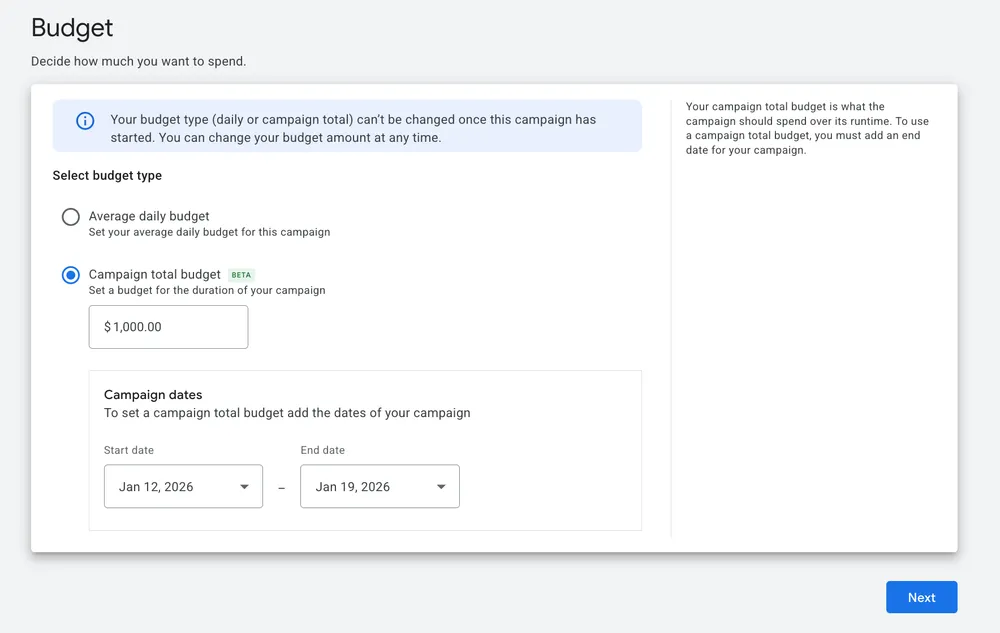
Now available in open beta, this change enables advertisers to set a fixed budget for the entire campaign duration (ranging from a few days to several weeks) rather than managing their spend daily.
The move addresses one of the biggest challenges in digital advertising: balancing spend control with performance optimisation.
It is useful especially during short-term or time-sensitive campaigns.
What Are Total Campaign Budgets?
Total campaign budgets allow marketers to define:
- A single and fixed budget for the entire campaign
- A specific start and end date
- Automatic budget pacing managed by Google’s optimisation systems
Instead of enforcing strict daily spending limits, Google dynamically adjusts daily spend to ensure the campaign:
- Does not exceed the total budget
- Uses the full budget effectively by the end date
- Capitalises on high-performing days while pulling back during slower periods
This approach gives Google more flexibility to allocate spend where and when it is most likely to deliver results.
Why This Update Matters
Budgeting Has Always Been a Pain Point
Managing budgets for short-term campaign flights, such as product launches, flash sales, seasonal promotions, or limited-time offers, has traditionally required hands-on attention.
Marketers often find themselves:
- Raising daily budgets to avoid underspending
- Lowering budgets to prevent overspend during high-traffic periods
- Making frequent manual adjustments that consume time and attention
Even with automation, daily budget caps often created inefficiencies, leading to missed opportunities or rushed end-of-campaign spending.
A Longstanding Gap in Search Campaigns
While Performance Max users already had access to total campaign budgets, Search advertisers, arguably Google Ads’ most mature and widely used audience, were left without this flexibility.
Bringing this feature to Search and Shopping closes that gap and signals Google’s intent to standardise budget automation across campaign types.
How Total Campaign Budgets Work in Practice
Once a total budget is set, Google’s systems:
- Monitor performance trends throughout the campaign
- Adjust daily spend based on predicted opportunity
- Pace delivery to ensure full budget utilisation by the end date
This means a campaign may spend more on high-intent days and less when demand is weaker, without exceeding the overall limit.
Ideal Use Cases
Total campaign budgets are especially effective for:
- Promotional bursts (sales events, holiday offers)
- Product launches
- Short-term experiments or A/B tests
- Seasonal or event-driven campaigns
- Brand activations with fixed funding
The Big Picture: Less Maintenance, More Strategy
At a strategic level, this update represents a shift in how advertisers interact with Google Ads. Instead of micromanaging budgets, marketers can now:
- Launch campaigns with greater confidence
- Reduce time spent on daily monitoring
- Focus more on creative, messaging, audience strategy, and measurement
For agencies and in-house teams alike, this translates into operational efficiency and fewer reactive decisions.
What’s Available Now
As of the open beta rollout, total campaign budgets are supported across:
- Search campaigns
- Shopping campaigns
- Performance Max campaigns
Advertisers can apply the feature when creating or editing campaigns with defined durations.
What This Signals For The Future
Google’s continued investment in automation suggests a broader trend toward:
- Fewer manual controls
- Smarter pacing and optimisation
- Outcome-focused campaign management
As these systems mature, advertisers who adapt early may gain an edge by reallocating time from execution to strategy, testing, and innovation.
Final Thoughts
Total campaign budgets are a meaningful evolution in Google Ads management.
By removing the friction of daily budget tweaks, Google is giving marketers greater confidence, control, and clarity, especially for short-term and high-stakes campaigns.
For advertisers juggling multiple promotions or working within strict budget windows, this feature could quickly become the new default.
Need a fresh perspective? Let’s talk.
At 360 OM, we specialise in helping businesses take their marketing efforts to the next level. Our team stays on top of industry trends, uses data-informed decisions to maximise your ROI, and provides full transparency through comprehensive reports.








.png)


