



OpenAI has officially launched its first real-world test of advertising inside ChatGPT, introducing sponsored messages within the app for a limited group of users.
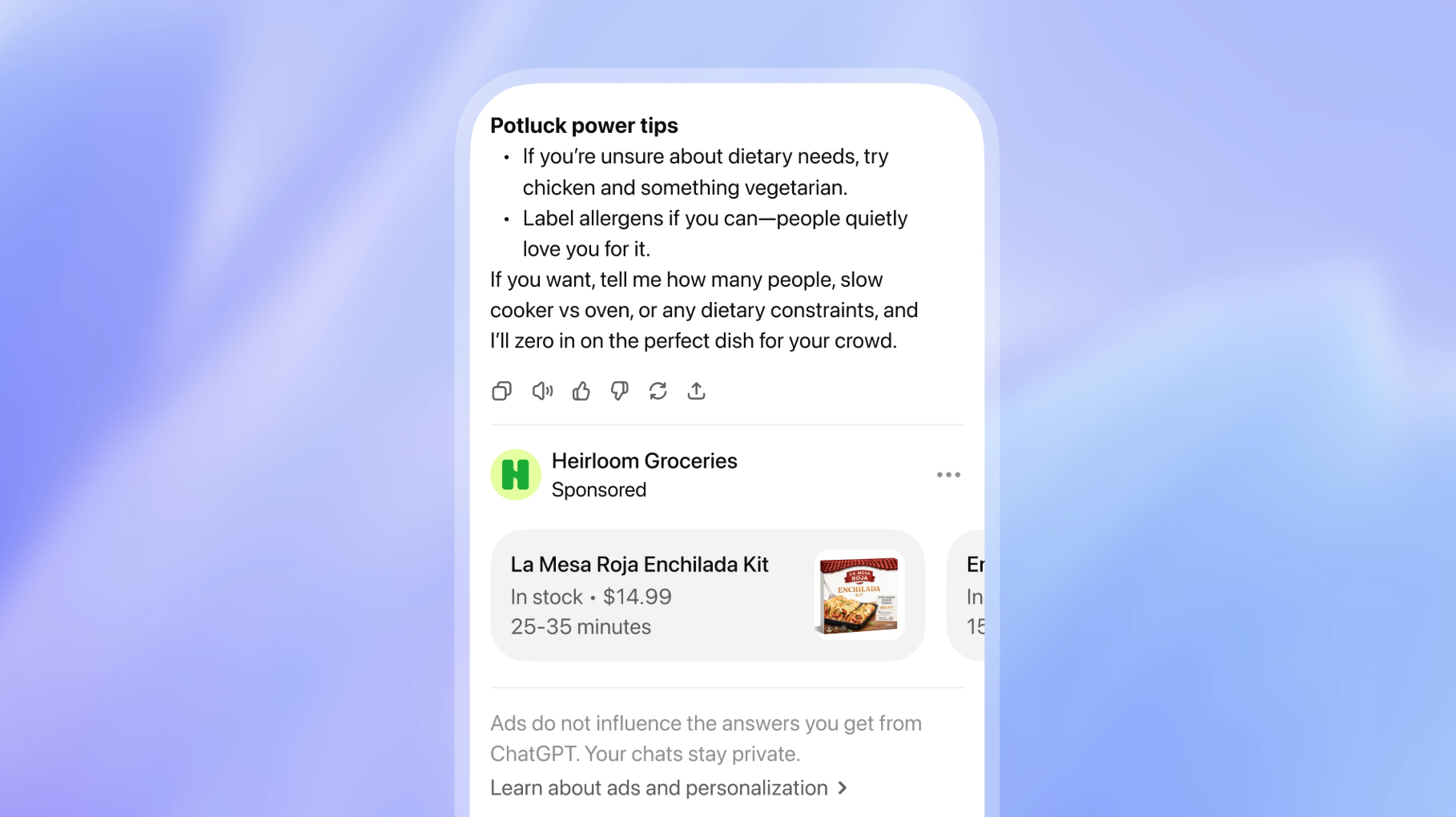
The ads will appear in a dedicated section beneath the chat interface, not inside ChatGPT’s responses, so there is a clear visual separation from the AI’s answers. During this initial phase, ads will be shown to logged-in users on:
- Free tier subscription
- Lower-cost Go subscription
OpenAI says advertisers will not have access to user conversations or the ability to shape ChatGPT’s replies, even as ads are tailored based on what the company deems most relevant and useful to each user.
The decision to test ads inside ChatGPT marks a watershed moment for digital advertising. For years, brands have optimised for search engines, social media feeds, and influencer marketing. With conversational AI, a new space opens up where consumers don’t just search or scroll, but think, ask, plan, and decide in dialogue with an AI.
From an advertiser’s standpoint, this is not just another ad placement opportunity. It represents a fundamentally different way to reach consumers and influence how people make decisions in real time.
Here’s everything you need to know.
Why This Matters to Advertisers
ChatGPT is not a typical platform. It is not a social network, a marketplace, or a search engine. It is a decision-making companion.
Users turn to ChatGPT when they are:
- Planning meals
- Researching products
- Brainstorming ideas
- Solving problems
- Comparing options
- Making personal or professional decisions
This creates a unique advertising environment where brands can be introduced at the exact moment of consideration, rather than interrupting attention in a feed.
For advertisers, this shift is profound:
- Instead of shouting for attention, brands can be invited into a conversation.
- Instead of guessing user intent, ads can align with real, active decision-making.
- Instead of blanket targeting, ads can be contextually matched to what users are actually doing.
How Ads Work: From an Advertiser’s Lens
During this initial test, OpenAI is taking a cautious, privacy-first approach. Ads appear in a clearly labelled section beneath the chat, not inside the AI’s responses. This is critical for advertisers because it preserves user trust while still creating visibility.
Ads are selected based on three main signals:
- Current conversation topic
- Past chats (at a high level, not shared with advertisers)
- Past interactions with ads
Example scenarios advertisers should love:
- A user asks for a pasta recipe → shows meal kit or grocery delivery ads
- A user asks for budget travel tips → shows airline or hotel ads
- A user plans a workout routine → shows fitness equipment or supplement ads
- A user researches home renovation → shows contractor services or tools
This is not random advertising. It is intent-aligned advertising.
If multiple advertisers qualify, OpenAI prioritises relevance rather than the highest bid, at least in this test phase. That suggests quality, fit, and usefulness may matter more than raw spending power.
Privacy Constraints: Challenge or Opportunity?
Some advertisers may feel limited by OpenAI’s strict privacy stance:
- Advertisers cannot see user conversations
- They cannot access personal data
- They only receive aggregate performance metrics
However, this is actually a strength, not a weakness.
Why?
Consumers are skeptical of surveillance advertising.
A system that:
- Matches ads contextually
- Protects user privacy
- Avoids creepy micro-targeting
…is more likely to build trust, engagement, and long-term effectiveness.
For brands, this means success will depend less on data exploitation and more on:
- Creative relevance
- Value alignment
- Smart positioning
- Helpful messaging
In other words: better advertising, not more invasive advertising.
User Control: What Advertisers Must Respect
OpenAI is giving users significant control over their ad experience:
Users can:
- Dismiss ads
- Delete their ad history
- Turn off personalisation
- Opt out of ads entirely (with fewer free messages)
For advertisers, this means:
- Bad ads will be quickly rejected
- Irrelevant ads will be ignored
- Annoying ads will be hidden
The upside? Brands that truly provide value are more likely to be welcomed rather than tolerated.
This forces a higher standard of advertising quality.
What This Means for Different Types of Businesses
1. E-Commerce Brands
ChatGPT could become a powerful product discovery engine.
Instead of relying solely on Google Shopping or Meta ads, brands can appear when users are actively planning purchases.
Example:
- User: “Help me plan a dinner party for 10 people.”
- Ad: A catering kit, meal box, or grocery delivery service.
That is high-intent advertising.
2. Local Businesses
Local services stand to benefit significantly.
If someone asks:
- “How do I fix a leaky faucet?”
- “Find a reliable plumber near me.”
A local plumbing service could be surfaced at the right moment.
This bridges the gap between advice and action.
3. Travel & Hospitality
People often ask ChatGPT for:
- Travel itineraries
- Budget planning
- Best destinations
- Hotel recommendations
Contextual ads could position airlines, hotels, or travel services right when decisions are being formed.
4. SaaS & Digital Tools
Professionals use ChatGPT for productivity and problem-solving.
Imagine:
- User: “What’s the best way to manage my team remotely?”
- Ad: A project management tool.
That’s not an interruption. It’s assistance.

Risks Advertisers Should Watch
While the opportunity is huge, there are risks:
- Over-commercialisation could irritate users
- Poorly matched ads could damage brand perception
- Users might feel manipulated if ads seem too “aligned” with personal chats
- Competition for prime conversational contexts may become intense
Brands must approach this space with care, authenticity, and respect for user experience.
The Bigger Picture: The Future of Advertising
This move signals a broader shift in digital marketing:
- From: “Show ads where users scroll.”
- To: “Show ads where users think.”
ChatGPT advertising is not about capturing attention. It’s about being present at moments of intention.
Over time, we may see:
- More ad formats
- Sponsored brand experiences
- AI-assisted product recommendations
- Interactive brand placements
- Conversational commerce integrations
This could redefine what digital advertising looks like in the AI era.
Bottom Line
For advertisers, OpenAI’s test is not just another ad channel—it is the first glimpse of an AI-native advertising ecosystem. Brands that learn how to add value in conversations, rather than disrupt them, will thrive. Those who treat ChatGPT like just another billboard will fail.
The winners will be brands that understand:
In the age of AI, relevance beats reach.
Need a fresh perspective? Let’s talk.
At 360 OM, we specialise in helping businesses take their marketing efforts to the next level. Our team stays on top of industry trends, uses data-informed decisions to maximise your ROI, and provides full transparency through comprehensive reports.






.png)


