



Google is rolling out a significant update to how budget pacing works for campaigns that use ad scheduling. The implications could be huge for advertisers who rely on limited run times to manage monthly spend.
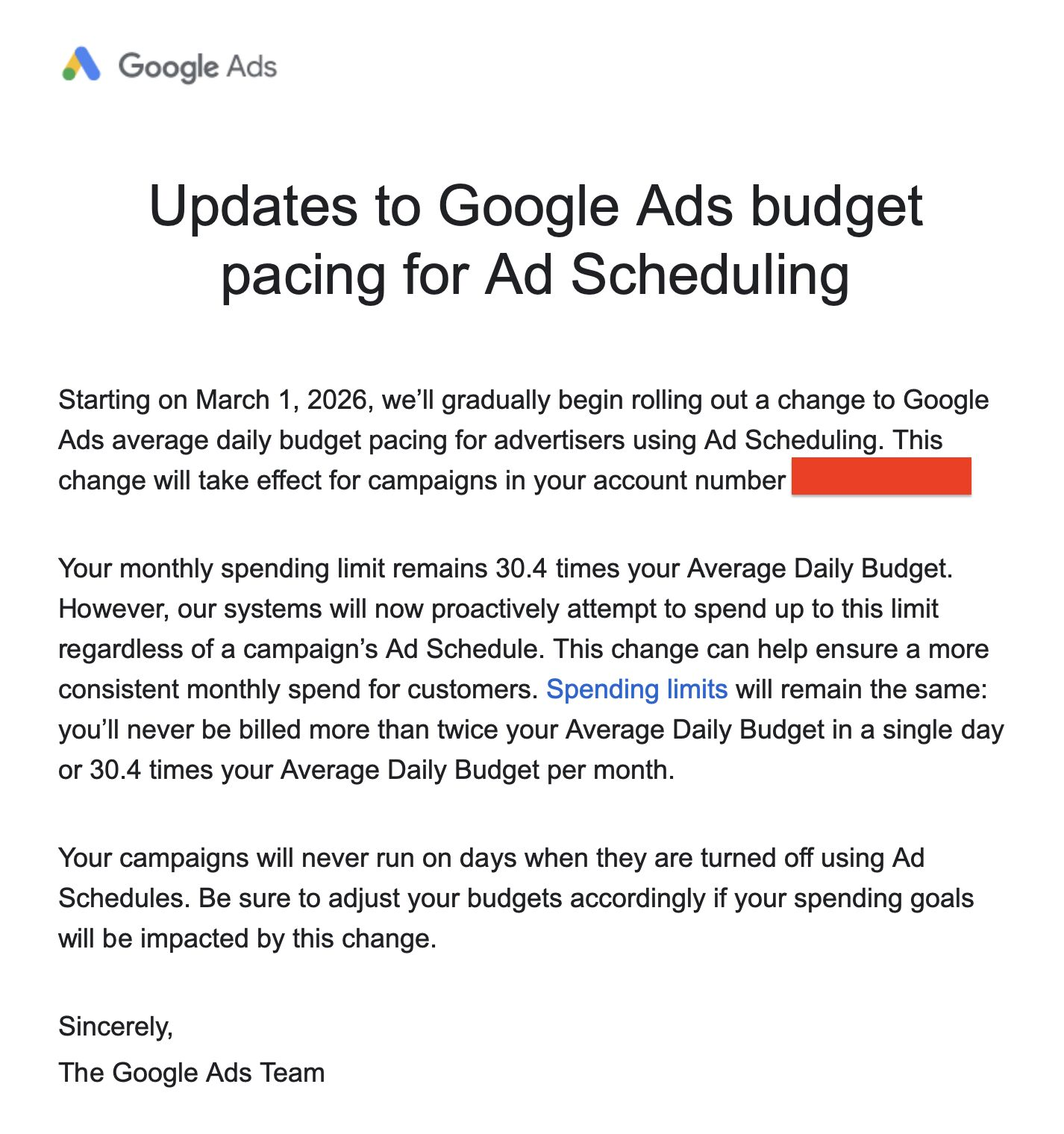
Starting March 1, Google Ads will pace budgets to spend up to the full 30.4x monthly limit of a campaign’s average daily budget, even if that campaign only runs on specific days or hours.
While billing safeguards remain intact, the way Google uses those safeguards is changing. This is not a policy shift in spending limits. It is a shift in how aggressively Google pursues them.
What’s Changing in Budget Pacing?
Under the new system:
- The 2x daily overspend rule remains in place.
- The 30.4x average daily budget monthly cap remains unchanged.
- Campaigns will not run outside their defined ad schedule.
However, Google will now attempt to hit the full 30.4x monthly ceiling within the scheduled run times.
Previously, campaigns that ran only on selected days often spent less because pacing aligned more closely with actual active days. That dynamic is changing.
Now, Google will compress spend more into the allowed schedule window.
How It Works: The Mechanics Behind the Update
To understand the impact, it’s important to revisit two key Google Ads rules:
1. The 2x Daily Overspend Rule
Google can spend up to twice your average daily budget on a given day to optimise performance, but never more than 2x.
2. The 30.4x Monthly Cap
You will never be billed more than 30.4 times your average daily budget in a given month.
These safeguards remain unchanged. What’s new is how Google distributes that spend within scheduled timeframes.
The Core Shift
Instead of pacing based on active days alone, Google will now aim to reach the full monthly billing limit regardless of how many days your ads are eligible to run, as long as they are scheduled.
A Simple Example: Weekend-Only Campaigns
Let’s break this down with a practical scenario.
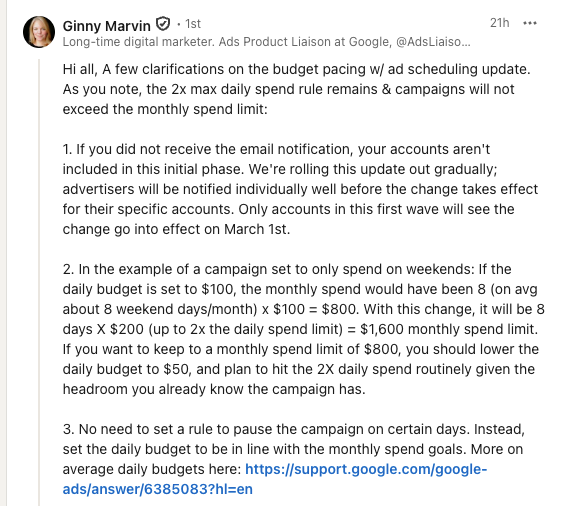
Before the update:
- Campaign runs weekends only.
- Average daily budget: $100.
- Approx. 8 weekend days per month.
- Monthly spend: roughly $800 ($100 x 8 days).
Because the campaign was only active on weekends, spend naturally stayed low.
After the update:
- Same weekend-only schedule.
- Same $100 daily budget.
- Google can now push up to $200 per scheduled day (2x rule).
- 8 days x $200 = $1,600.
The campaign could now reach $1,600 in monthly spend (double what it previously spent) while still staying within Google’s official billing caps.
Nothing “illegal.” Nothing exceeding policy limits. Just different pacing logic.
Why This Matters for Advertisers
For many advertisers, ad scheduling has functioned as a soft budget control lever. By restricting campaigns to certain days or hours:
- Spend was naturally suppressed.
- Monthly totals stayed below theoretical caps.
- Budget pacing felt more predictable.
- That safety net is disappearing.
Now, Google will work to maximise spend potential within the approved schedule, meaning:
- Weekend-only campaigns may see sharp increases.
- Part-time campaigns could consume full monthly caps.
- Monthly projections based on historical pacing may no longer hold.
- If you are not actively recalibrating daily budgets, you may overshoot internal targets.
What Google Says About the Update
According to Google Ads leadership, the intent is to better align pacing behaviour with advertiser expectations around monthly budget limits.
Key clarifications include:
- Only advertisers who received direct notification are included in the initial rollout.
- The rollout will occur gradually.
- Campaign objectives (conversions, conversion value, etc.) still influence delivery.
- Billing protections remain intact.
The update is positioned as a consistency improvement and not an expansion of billing authority.
Between the Lines: A Strategic Shift
This update reflects a broader theme in Google Ads automation:
Maximise available headroom unless constrained.
Google is optimising toward full utilisation of allowed limits. If a campaign is eligible to spend more within defined caps, the system will attempt to do so, especially when machine learning predicts incremental value.
For advertisers who used scheduling as a spending throttle, this marks a big shift:
- Scheduling controls when ads run.
- Budget controls how much they can spend.
- Google will now separate those two concepts more strictly.
Who Is Most Affected?
This change will most impact advertisers who:
- Run campaigns only on weekends.
- Limit ads to business hours.
- Use heavy dayparting strategies.
- Have historically underspent due to schedule constraints.
- Manage fixed monthly media plans.
Enterprise advertisers with strict monthly allocations may need to revisit budget frameworks immediately.
What To Do Now
1. Audit Campaigns Using Ad Scheduling
Identify all campaigns with restricted run days or hours.
2. Recalculate Daily Budgets
If your true monthly target is lower than 30.4x daily budget, adjust accordingly.
Formula to maintain prior monthly spend:
Previous Monthly Spend ÷ 30.4 = New Average Daily Budget
3. Lower Daily Budgets if Needed
If you want to maintain historical monthly spend levels, you must reduce daily budgets to compensate for the more aggressive pacing.
4. Monitor Early March Closely
Watch:
- Daily spend spikes
- Pacing trends
- Impression share changes
- CPA or ROAS fluctuations
5. Communicate with Finance Teams
If you operate within fixed monthly caps, ensure internal stakeholders understand the change to avoid budget surprises.
Strategic Considerations
This update is not inherently negative. In fact, it could:
- Improve volume for high-performing limited schedules.
- Increase conversion opportunities during peak days.
- Enhance learning signals by pushing harder on active days.
However, it reduces passive budget suppression and increases the importance of intentional budget design.
Final Thoughts
Google is not raising spending limits. It is changing how it uses them.
For advertisers who engineered schedule-based spending control, this update removes a buffer and shifts responsibility back to daily budget calibration.
The takeaway is simple:
If you want to control monthly spend, control your daily budget, not just your schedule.
March 1 marks more than a pacing tweak. It signals another step toward fully optimised, fully utilised automation in Google Ads.
Need a fresh perspective? Let’s talk.
At 360 OM, we specialise in helping businesses take their marketing efforts to the next level. Our team stays on top of industry trends, uses data-informed decisions to maximise your ROI, and provides full transparency through comprehensive reports.








.png)


